Introduction
When people start looking into a pool project, one of the first things they ask about is a spa or hot tub. And to be fair, that makes complete sense. A spa is one of those features everyone knows sounds really nice to have, and on paper, it's a great addition.
Once you dig into the details, though, it isn't always as simple as it sounds. There's a real difference between a spa and a hot tub, and there's a real cost attached to each. In a lot of cases, once customers see the full picture, they decide it isn't quite worth the investment and wouldn't add as much to their project as they first thought. Some customers, hear the real details, and still decide it's worth the investment.
So I wanted to put together a quick post on the differences between a spa and a hot tub, what each one costs, and how to tell whether one makes sense for your backyard.
If you'd rather watch than read, we cover all of this in a video here:
What is a Hot Tub?
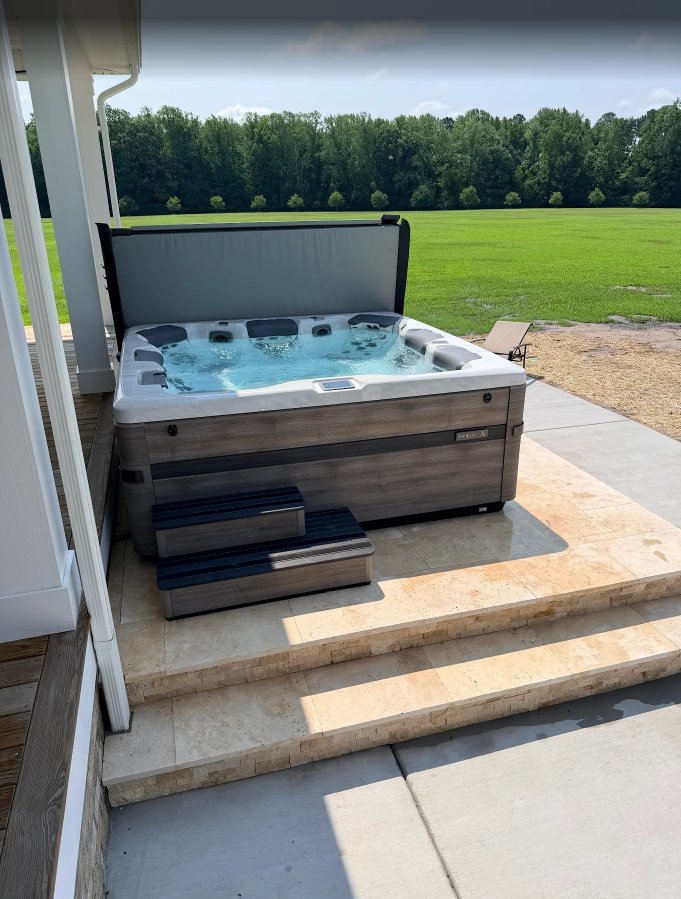
A hot tub is a fully insulated, very therapeutic unit, usually with 20+ jets. It's the kind of thing you would purchase traditionally from a warehouse or showroom floor, a common brand would be Jacuzzi. Each unit has its own pump and heater, so it's more of a packaged deal. There isn't much construction involved. It's a pre-made unit that's typically set on top of a pad of some sort.
Because of that, hot tubs come with a lot of jet pressure, heat up more easily, and have a lower heating demand. Overall, a hot tub is usually what people are actually looking for when they ask about a spa, at least on the function side. It may not check every aesthetic box, but it traditionally checks the function boxes.
What is a Spa?
A spa, on the other hand, is a body of water that's usually kept around 95 to 100 degrees. It's not insulated, and it traditionally has only 6 to 10 jets. In most cases, a spa doesn't have its own pump and heater either. Depending on how it's plumbed, it usually shares the same pump and heater as the pool.

How Much Does a Spa Cost?
One of the most common questions you may be asking is, "Well, how much does a spa actually cost?"
In my years of experience, spas are one of the most inconsistent features when it comes to pricing. I've seen some installers do them for as little as $10,000 to $15,000. More commonly, though, I find the average range is between $23,000 and $40,000.
Where you land in that range usually comes down to a few things:
1) Fiberglass or gunite: What type of spa you're installing.
2) Plumbing: Whether the spa runs off a single set of equipment shared with the pool, or its own separate set.
3) Height: How high out of the ground the spa sits.
4) Skirting: What you're finishing the outside walls with. Is it a veneer or a waterline tile? If it's a veneer, what kind, and how much does it cost? There's a little bit of nuance there.
5) Coping: What material you're capping it with.
How Much Do Hot Tubs Cost?
Hot tub pricing covers a wide range too, but most customers can spend anywhere from $6,000 to $12,000 and get a pretty solid, nice hot tub.
There are exceptions to the rule. You can definitely find hot tubs at $20,000 and up, but most of the time those are loaded with extra features that I personally consider negligible. When I want a hot tub, I just want a tub that's hot, with therapeutic jets and comfortable seating. I'm not too concerned about the extras that push the price past that $20K mark.
For a solid tub, $6,000 to $12,000 is a very consistent range.
Who Is a Fiberglass or Gunite Spa Good For?
A fiberglass or gunite spa is a good fit for customers who want to enhance their project aesthetically and aren't necessarily looking for something extremely therapeutic. That's not the reason they're making the purchase. They're mostly looking for a body of water that can heat up to around 95 to 102 degrees and has higher jet pressure than the pool.
They're also not planning to hop in on a whim. That's an important note.
Why Spas Take Some Planning
One of the main things to understand about a spa is that it isn't insulated. Once the heater turns off, the temperature is no longer being regulated. Since there's traditionally no insulation around a spa, and in most cases no cover either, the water will generally settle back to the outside temperature.
You might ask, "Why not just keep the heater running so it's ready whenever I want it?" The reason most customers don't, is that the utility cost of keeping a fiberglass or gunite spa hot around the clock would be quite high.
So it's worth knowing that a spa takes a little planning. Traditionally, you'll want to turn the heat on 1 to 3 hours before you plan to use it.
A hot tub, on the other hand, regulates its own temperature. And if the water is running a little low, it'll usually heat back up while you're sitting in it.
Single Set vs. Double Set of Equipment
One thing to consider when you're buying a spa is whether the equipment will be a single set or a double set.
Single Set
A single set means the pool and spa both run on the same pump, filter, heater, chlorinator, and so on. This is traditionally our preferred way to install a pool and spa, for a few reasons:
One heater for both: You can use the gas heater for the pool and the spa.
Lower operating cost: Long-term, it costs less to run.
Smaller footprint: Having everything on one set of equipment takes up less space, which makes it easier to hide. Equipment generally isn't the most attractive thing to look at.
Easier to use: It keeps things a little more user-friendly.
The main drawback is that, in most cases, you can't have water coming out of the pool jets and the spa jets at the same time. With only one pump, the water has to go through either the pool or the spa.
From a maintenance standpoint, the way we usually set this up is that the pool circulates about 90% of the time. For the other 10% of the day, it switches over to the spa and runs long enough to filter all the water in the spa a few times. Any other time you want to use just the spa or just the pool, you simply select the matching button.
Double Set
Some customers go with a double set because they specifically want jets running in the pool and the spa at the same time. To do that, you traditionally need a separate pump for each.
The upside is that both bodies of water can filter and circulate at the same time. The drawbacks:
1) Double the footprint: Your equipment area just doubled in size.
2) More to manage: You'll have two pumps, two filters, and essentially two of everything, which can feel a little overwhelming.
3) Higher replacement costs: Long-term, you'll spend more when that equipment eventually wears out.
4) More service calls (Potentially): Like anything else, pools aren't always perfect, and equipment sometimes runs into small issues. With twice the equipment of a typical setup, you may be more likely to run into them.
In Conclusion
Spas can really enhance a project, as long as your expectation is a tub of hot water, usually around 95 to 102 degrees, with slightly higher jet pressure than the pool. If that's what you're after, a spa is a great fit. It adds a lot to a project aesthetically, and if it's plumbed the right way, you can use the same gas heater for both the pool and the spa. All in all, a spa can enhance a project tremendously.
However, some customers are looking for the traditional function of a hot tub. They want it insulated, they want it holding its temperature all the time so they can hop in whenever they feel like it, and they're not too concerned about the aesthetic side. For those customers, a traditional hot tub is the way to go, and at a lower investment.
Hopefully this helps as you think through your pool purchase. If you're looking into a pool project and would like some help, feel free to fill out [https://elitepoolsnc.com/] and we'll reach out. Thank you!